Dressing for Cold Weather
Wear clothing that will keep you warm and dry. The “wind chill factor” can lower the temperature considerably. For example, suppose the thermometer reads 30° Fahrenheit (-1° Celsius). If you ride at 25 miles per hour (40 km/h), the wind chill temperature drops to 16° Fahrenheit (-9° Celsius).
- Dress in layers, which offer superior insulation. As the weather warms up, you can shed a layer at a time to stay comfortable. Three layers are recommended.
- Vapor transmission layer: Worn next to the body, it draws moisture from the skin while retaining warmth. This layer may be made of material such as polypropylene.
- Insulating layer: Weightier or bulkier than the first layer, it holds warm air around you. Use wool in dry conditions, and synthetics or fleece in wet conditions.
- Protective outer layer: Available in various weights and materials according to conditions, it protects the inner layers from water and wind.
- Wear a warm ski mask or other head covering under your helmet.
- Wear gloves with gauntlets to prevent cold air from blowing up your sleeves.
- Use a turtleneck shirt or dickey to keep your neck warm.
- In extremely cold weather, wear two layers of socks—a heavy wool pair over a light pair.
- Do not wear:
- A scarf or loose clothing, which can get caught in the moving parts of your snowmobile or in branches and bushes
- A bubble-type face guard, which may frost up
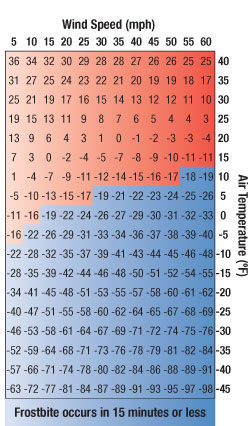
Wind chill is given in the body of this table.